LEGISLATIVE AFFAIRS
The San Diego Housing Commission (SDHC) actively monitors and engages with elected officials and stakeholders about legislative and regulatory activities that could affect SDHC’s rental assistance, homelessness solutions and affordable housing programs, serving thousands of households. SDHC works at the local, state, and federal levels of government to advance policies aligned with our vision, mission, purpose, core values, and strategic priorities.
SDHC identifies emerging issues and legislation that could affect the individuals and families its programs serve. SDHC leverages these insights to provide targeted policy recommendations and propose and advocate for measures that strengthen housing stability and expand housing solutions in the City of San Diego.
AFFORDABLE HOUSING PRESERVATION ORDINANCE
Preserving existing quality affordable housing is crucial to addressing the City of San Diego’s housing challenges. During Fiscal Year (FY) 2025, SDHC conducted extensive outreach to receive input and collaborated with the San Diego City Attorney’s Office to create a new city law. This ordinance will help preserve the affordability of housing units that have deed restrictions that require their rents to remain affordable for people with low income.
The San Diego City Council unanimously adopted this new city law in February 2025.
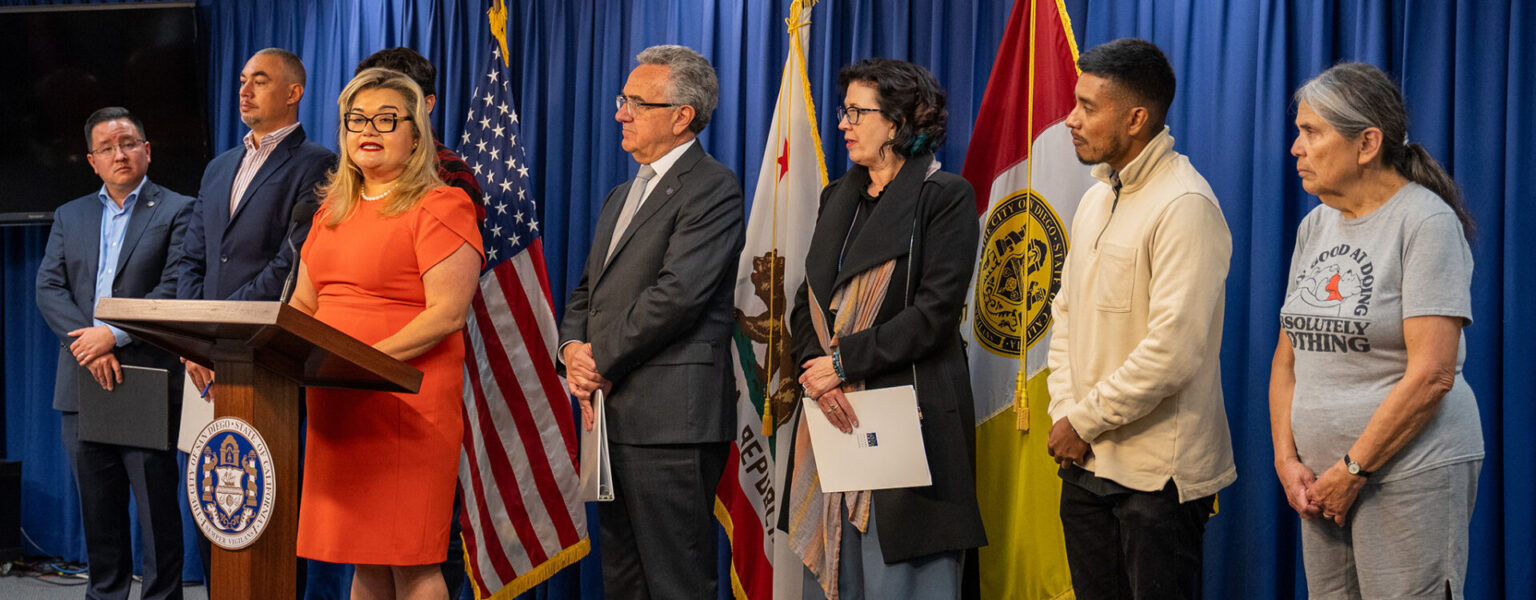
City Councilmember Vivian Moreno, who has led affordable housing preservation efforts as a member of the City Council’s Land Use and Housing Committee, held a news conference supporting the ordinance before the City Council vote. San Diego City Council President Joe LaCava, City Councilmembers Sean Elo-Rivera and Kent Lee, and SDHC President and CEO Lisa Jones participated to share support for adopting this new city law.
This ordinance will be a significant tool for the city. By helping to preserve affordable housing units, it will also help to prevent the displacement of the individuals and families who call these units home.
The city law will provide a way for the City, SDHC, local nonprofits and other qualified entities to know sooner when a property owner intends to sell. SDHC would then have a greater opportunity than exists under current state law to be able to acquire that property and ensure it remains affordable.
The creation of an Affordable Housing Preservation Ordinance was one of seven actions the San Diego City Council approved in October 2020 to implement a strategy for affordable housing preservation in the City. The seven actions emerged from discussions based on the SDHC report “Preserving Affordable Housing in the City of San Diego,” published in May 2020.
ADVOCACY
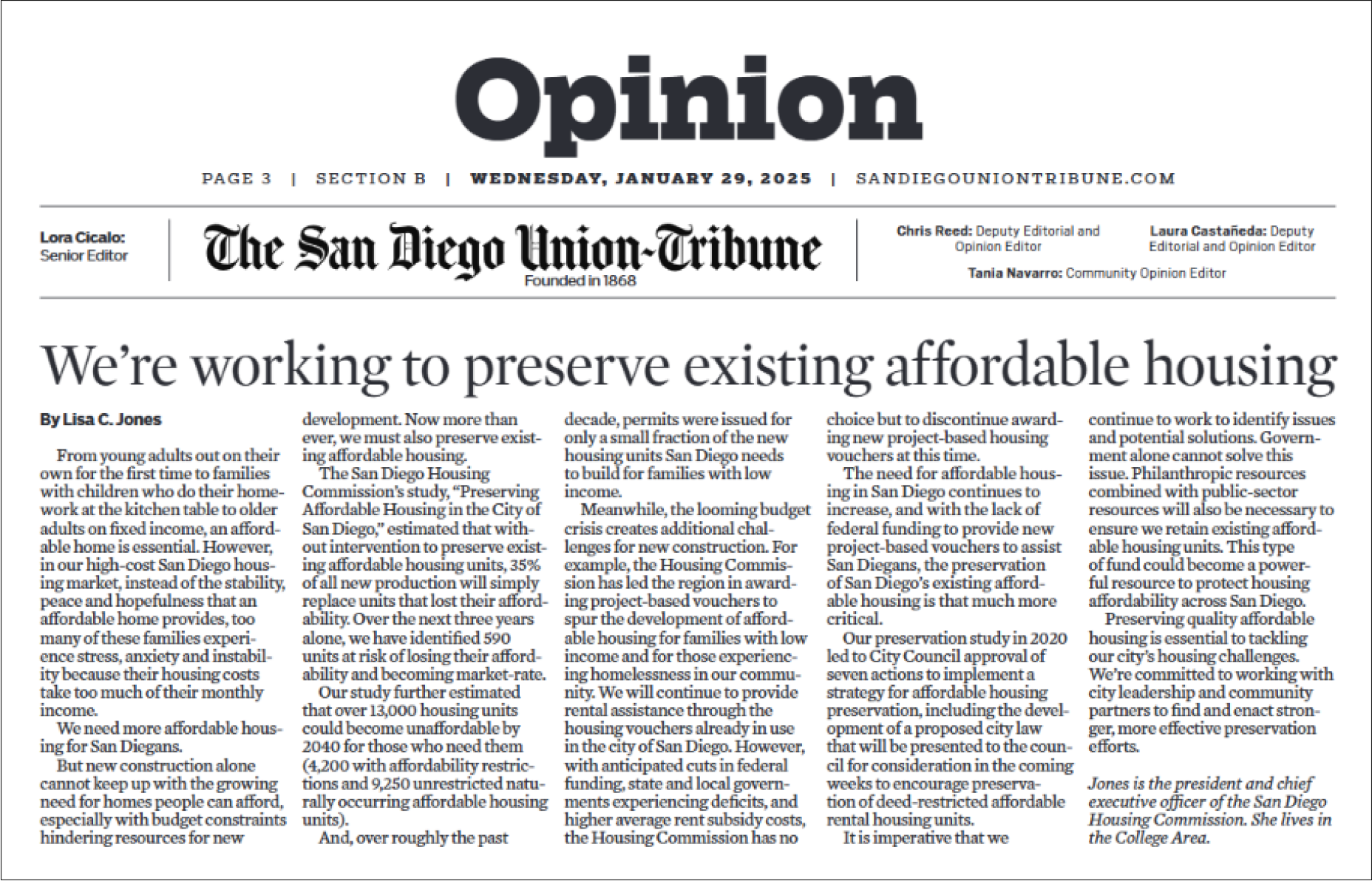
January 29, 2025: The San Diego Union-Tribune published SDHC President and CEO Lisa Jones’ op-ed supporting affordable housing preservation efforts.
OUTREACH
July – October 2024: SDHC staff presented the draft Affordable Housing Preservation Ordinance to 15 stakeholder groups for review and comments.

UPDATE: PRESERVATION FUND
September 4, 2025: SDHC staff presented to the San Diego City Council’s Land Use and Housing Committee a recommendation for the City Council to direct SDHC to establish an affordable housing preservation fund. This fund would enable SDHC or its nonprofit affiliate, Housing Development Partners, to acquire and preserve deed-restricted and naturally occurring affordable housing properties. Affordable housing covenants would be placed on the properties to require them to serve households with mixed incomes from 30 percent to 150 percent of San Diego’s Area Median Income (AMI). The covenants would also maintain the affordability of the properties in perpetuity. The committee voted unanimously to forward SDHC’s recommendation to the City Council.

STATE DISCUSSIONS ON
HOUSING AND HOMELESSNESS
The State of California’s engagement is essential for initiatives to address housing and homelessness. Discussions with state lawmakers are crucial as ongoing efforts continue. In February 2025, SDHC President and CEO Lisa Jones moderated a panel discussion with State Assemblymembers Chris Ward and Tasha Boerner on housing, homelessness, and state and local funding. She also met with State Assemblymember Dr. Darshana Patel.
These meetings were part of the San Diego Regional Chamber of Commerce delegation’s trip to Sacramento. Additional topics discussed often in a variety of conversations during the trip included the state budget, insurance costs and behavioral health policies. SDHC also spoke with local business leaders about the cost of living and housing challenges in San Diego; ways to collaborate on solutions to increase affordable housing, support workforce stability and reduce homelessness; and partnerships and strategies to improve access to housing.
FEDERAL FUNDING
Amid continuing uncertainty about federal funding for housing and homelessness assistance programs, SDHC in March 2025 met directly with U.S. Representatives Scott Peters and staff from the offices of U.S. Representatives Sara Jacobs, Mike Levin and Juan Vargas. SDHC also joined a California Association of Housing Authorities meeting with U.S. Senator Adam Schiff. These meetings provided the opportunity for SDHC to advocate to protect crucial federal funding for vital housing assistance programs, including Section 8 Housing Choice Vouchers and Project-Based Vouchers.
SDHC was also among a coalition of public housing authorities in California that engaged in an open forum with the U.S. Department of Housing and Urban Development (HUD) to highlight concerns about funding cuts and their implications.
ADVOCACY
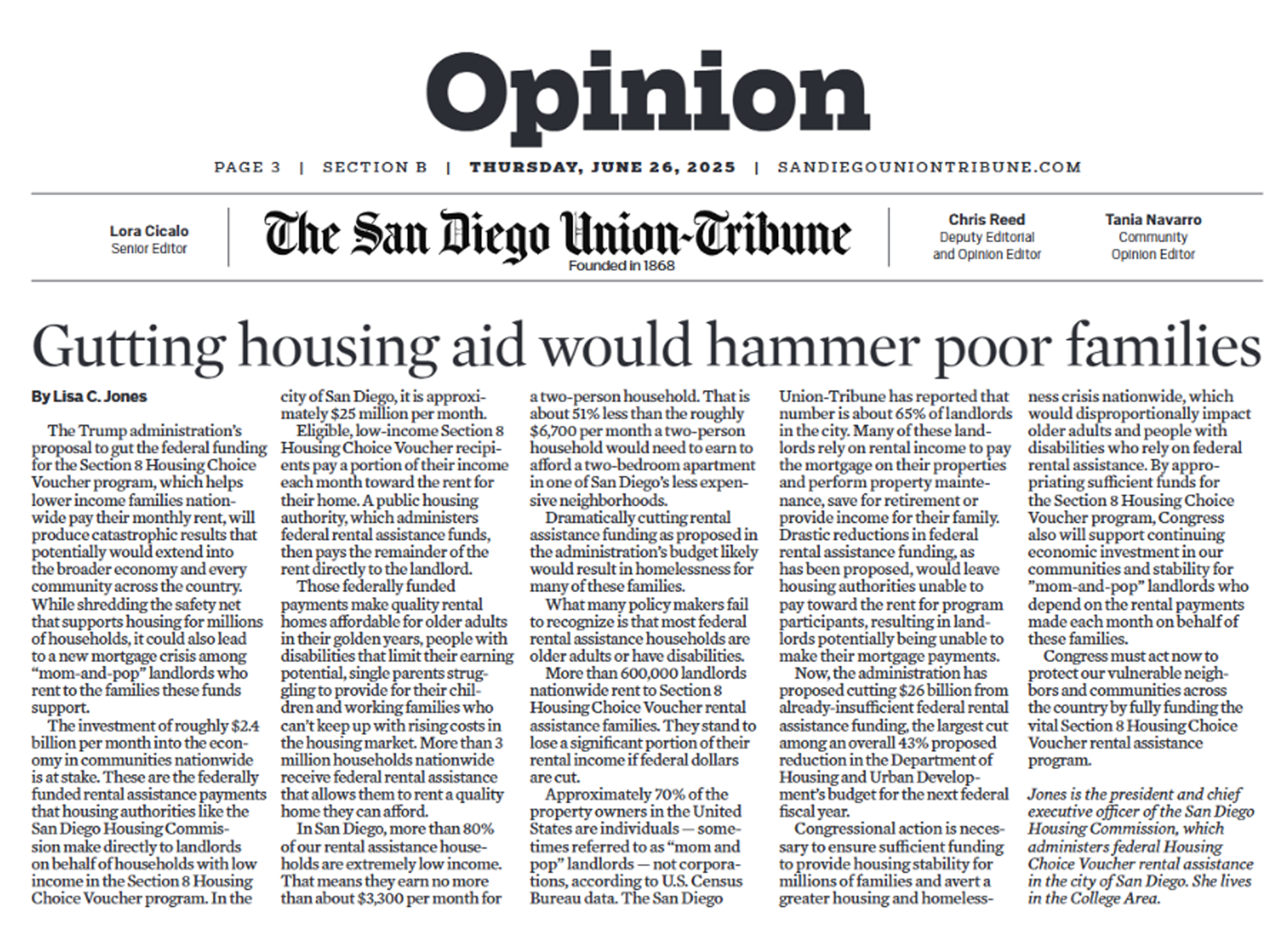
June 26, 2025: The San Diego Union-Tribune published SDHC President and CEO Lisa Jones’ op-ed, urging Congress to act immediately to secure sufficient federal housing voucher funding to protect vulnerable neighbors and communities nationwide.
MEETINGS WITH HUD
During a visit to Washington, D.C., in April, SDHC President and CEO Lisa Jones met with HUD Principal Deputy Assistant Secretary for Public and Indian Housing Benjamin Hobbs. The discussion included SDHC’s status as a “Moving to Work” (MTW) agency, the innovative initiatives SDHC has implemented with the flexibility MTW status provides, and how MTW status is an effective tool to stretch limited financial resources and pilot new policies and practices.
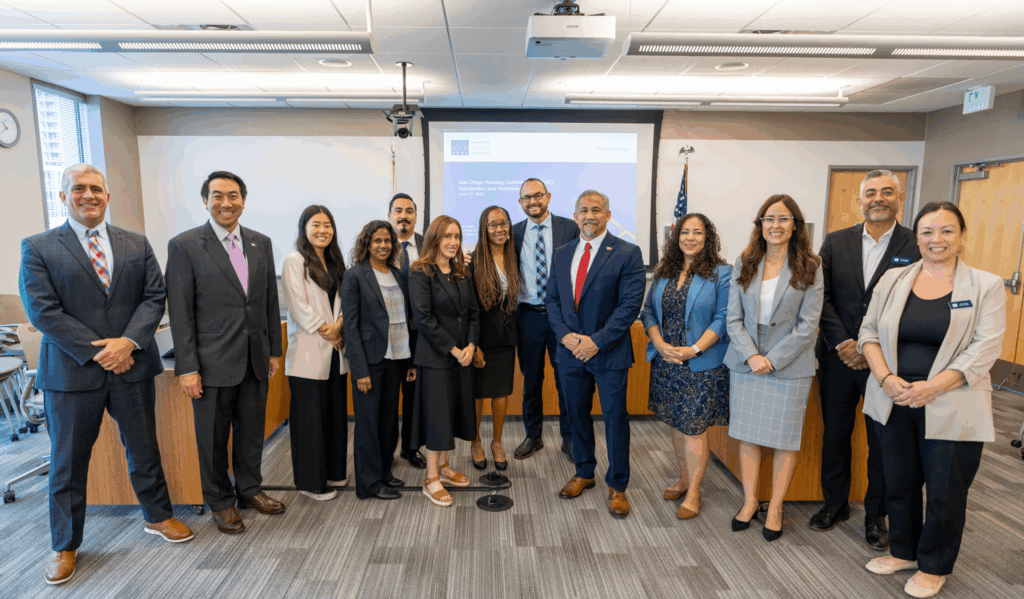
On June 12, 2025, HUD Region IX Administrator William Spencer met with SDHC during his visit to San Diego. He participated in the grand opening of SDHC’s Presidio Palms property, which provides 161 affordable rental homes with supportive services for people who experienced homelessness, and afterward met with members of SDHC’s leadership team at SDHC’s offices. They discussed details about SDHC’s MTW status and a variety of SDHC’s rental assistance and affordable housing programs. Regional Administrator Spencer also toured SDHC’s Hotel Churchill property, an award-winning renovation of a historic building that created 72 affordable housing units with supportive services for people who experienced homelessness, mainly veterans.
EMERGENCY HOUSING VOUCHERS
In March 2025, HUD notified public housing authorities, including SDHC, that funding for the Emergency Housing Voucher (EHV) program is ending five years sooner than expected. SDHC estimates that its existing EHV funding will cover the average EHV housing assistance payment until fall of 2026. At that time, SDHC will not be able to continue to help EHV households pay their rent.
To try to mitigate the negative effects the end of funding will have on these families, SDHC on May 29, 2025, asked HUD for several regulatory waivers. If approved, these waivers would allow SDHC to transfer EHV families to alternative housing options, if applicable and available.
One of the requested waivers was to create an EHV priority for SDHC waiting lists, including project-based vouchers. On June 20, 2025, HUD issued a notice that allows public housing authorities to transition EHV families to the Housing Choice Voucher program if those families are selected through the Housing Choice Voucher waiting list.
On July 18, the SDHC Board of Commissioners approved revisions to SDHC’s Section 8 Housing Choice Voucher Administrative Plan to create a local preference for current EHV families on SDHC’s Housing Choice Voucher waiting lists, including the waiting list for Project-Based Vouchers. While this will not resolve the housing challenges for all of SDHC’s EHV families, it is one of the steps SDHC has taken as it continues to work to assist these families. Section 8 Housing Choice Vouchers are not available due to insufficient funding. Only a minimal number of Project-Based Vouchers will become available before the EHV program’s federal funding runs out in fall 2026.