HOMELESSNESS SOLUTIONS
The San Diego Housing Commission (SDHC) operates programs that provide services directly to San Diegans at risk of or experiencing homelessness, administers City of San Diego homelessness shelters and services programs, and is a leader in collaborative initiatives, including the Community Action Plan on Homelessness for the City of San Diego. Through these efforts, SDHC participates in a spectrum of interventions to assist individuals and families, from shallow subsidies for people who are at risk of homelessness, homelessness prevention for people who are at imminent risk of homelessness and housing for people who are experiencing homelessness.
SDHC collaborates with the City of San Diego, the County of San Diego, the San Diego Regional Task Force on Homelessness (RTFH), federal and state government agencies, homelessness service providers, landlords, developers and community organizations on a variety of homelessness solutions.
HOMELESSNESS PROGRAMS AND SERVICES CITY- OR SDHC-FUNDED
Fiscal Year 2025 (July 1, 2024 – June 30, 2025)



COMMUNITY ACTION PLAN ON HOMELESSNESS
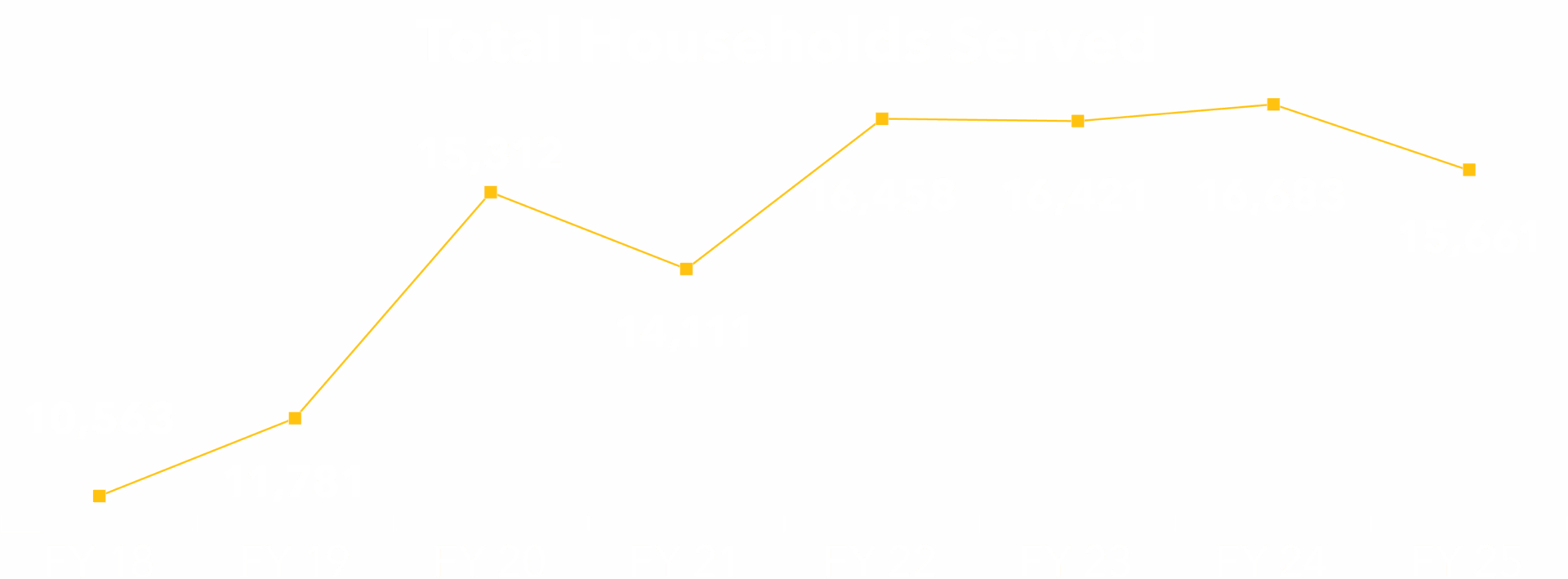
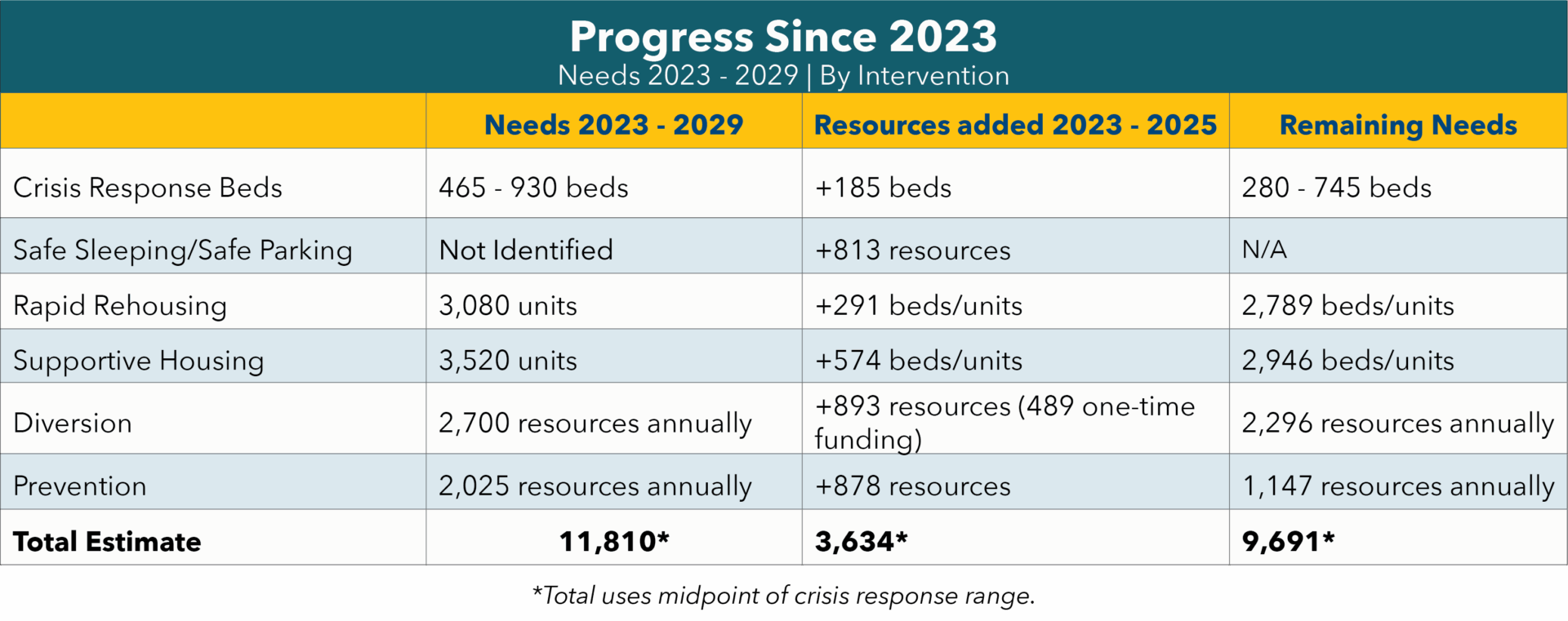
Progress continued in Fiscal Year (FY) 2025 toward addressing the needs identified in the Community Action Plan on Homelessness for the City of San Diego. On May 20, 2025, SDHC, the City of San Diego and RTFH presented an update to the San Diego City Council about the Community Action Plan. SDHC was one of the lead agencies in the creation of the Community Action Plan. It is a comprehensive, 10-year plan that builds on progress, lays out short-term achievable goals, and serves as a guide for long-term success in addressing homelessness.


STATE HOMEKEY FUNDS
The completion of two SDHC collaborative developments in FY 2025, utilizing State of California Homekey funds, produced 174 new affordable rental homes with supportive services for individuals experiencing homelessness in the City of San Diego. These are among more than 600 affordable rental homes created since 2020 with more than $105 million the Homekey program has awarded to SDHC collaborations. SDHC now owns and manages more than 550 of these units.

THE SHORES AT NORTH BEACH
The rehabilitation of a vacant multifamily housing property in Ocean Beach created 13 affordable rental homes for people experiencing chronic homelessness. SDHC submitted a joint application with the developer for State Homekey funds.
- Developer: Wakeland Housing and Development Corporation
- Financing:
- State Homekey Program: $3.9 million
- City of San Diego: $1.465 million
- County of San Diego: $1.465 million
- SDHC awarded 13 project-based housing vouchers to help residents pay their rent.
- County of San Diego supportive services funding: $1.66 million
- Completed: September 2024

Photos by Stephen Whalen
Presidio Palms
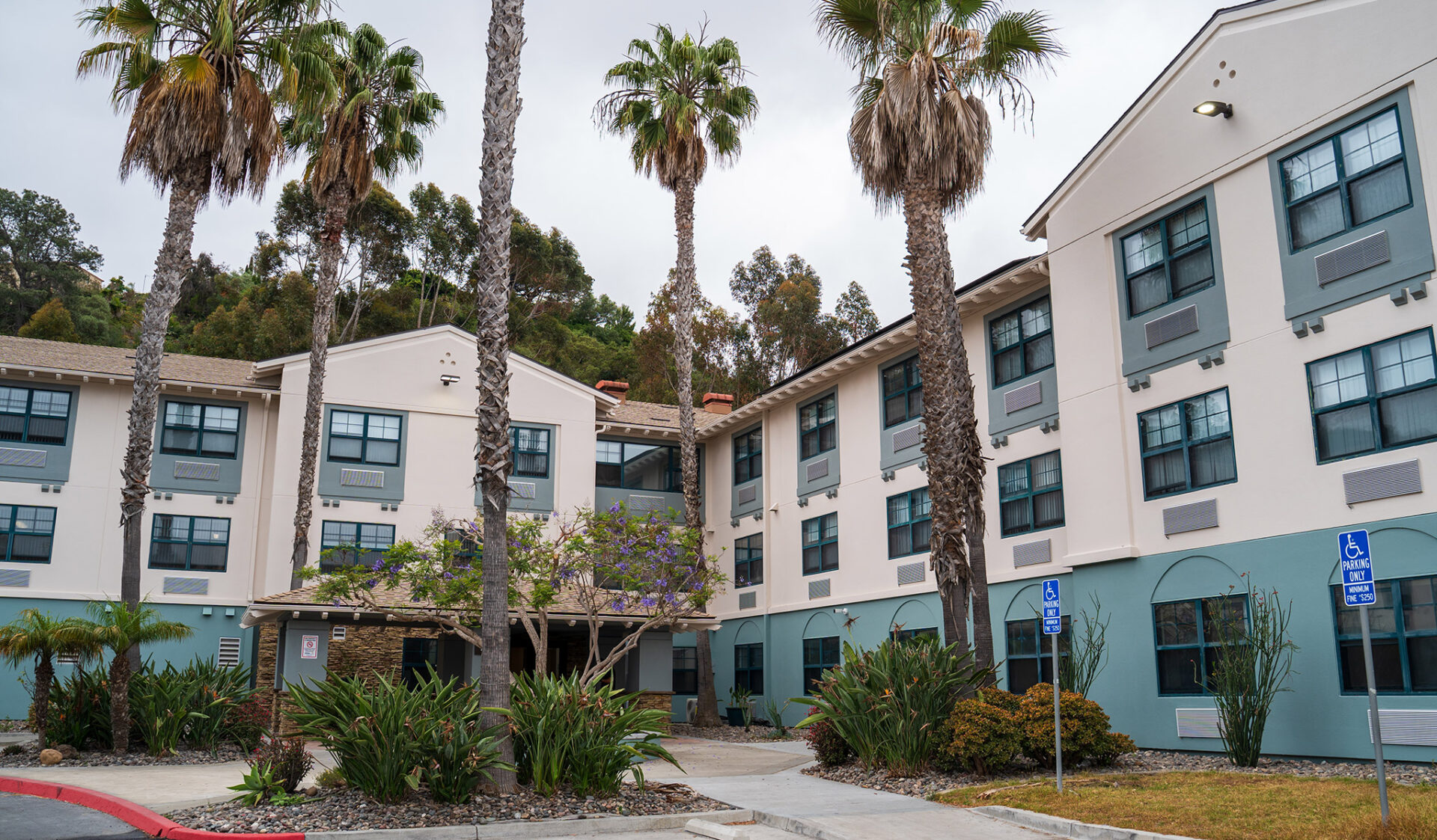
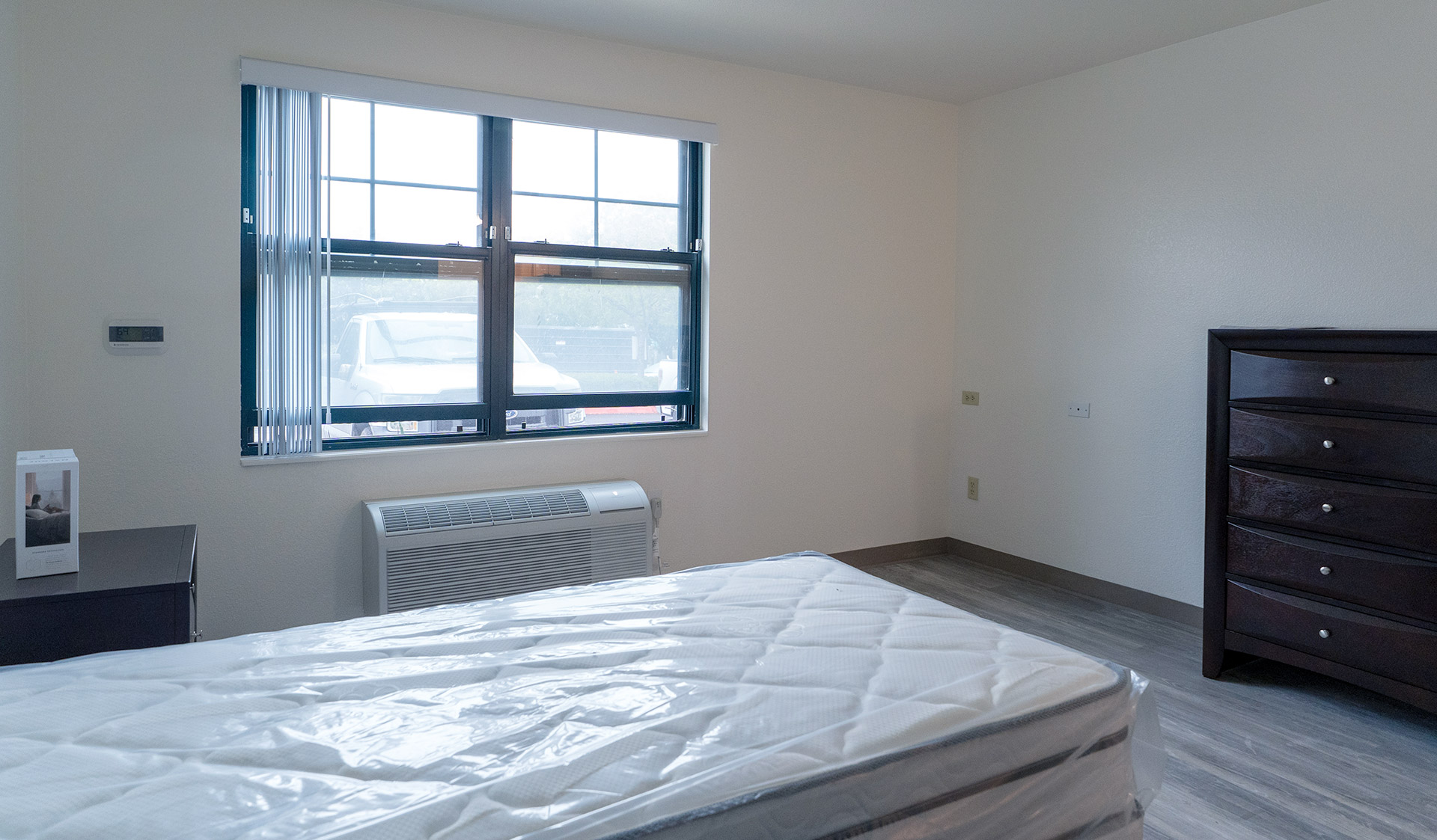
SDHC bought and rehabilitated a former extended-stay hotel in Mission Valley to create 161 new affordable rental homes with supportive services for people experiencing homelessness, including transition-age youth.
Developer: SDHC

Financing:
- State Homekey Program: $35 million
- City of San Diego: $17.8 million
- County of San Diego: $17.8 million
- Regional Task Force on Homelessness:
$1.1 million

SDHC committed 161 project-based housing vouchers to help residents pay their rent.
County of San Diego supportive services funding: $8.5 million
GRAND OPENING
- June 12, 2025
- Participants and attendees included:
- U.S. Department of Housing and Urban Development (HUD) Region IX Administrator William Spencer
- San Diego Mayor Todd Gloria
- San Diego City Council President Joe LaCava
- San Diego City Councilmember Sean Elo-Rivera
- California Department of Housing and Community Development Deputy Director of Federal Financial Assistance Jenny Cho
- County of San Diego Housing and Community Development Services Director David Estrella
- SDHC Board of Commissioners Chair Eugene “Mitch” Mitchell
- SDHC Commissioner Stephen Cushman
- SDHC Commissioner Melinda Vásquez
- SDHC Deputy CEO Jeff Davis
- Regional Task Force on Homelessness CEO Tamera Kohler
- Representative from San Diego City Councilmember Stephen Whitburn’s office
- Representatives from Telecare, the service provider for residents

BLESSED WITH A RENTAL HOME
Moving into SDHC’s Presidio Palms property has been a relief for Zeke after he lost his job and spent more than six months sleeping in his car in San Diego.
“Finding this property, it’s been a huge blessing, and it’s been a journey as well,” Zeke said.
Sleeping in his car without a bed or a regular place to shower was “very, very hard,” he said.
His situation changed when someone reached out to help him get into housing. He waited for an opportunity, and then, he received an email from SDHC about an apartment at Presidio Palms.
“It was amazing,” he said. “I was very, very blessed to have that email.”
With a bed, a kitchen and a bathroom of his own, Zeke said his apartment at Presidio Palms provides him the opportunity to live a “normal” life again.
He’s exploring returning to school and looking for another job that fits his interests.
“This is not my stop,” he said. “This is just a journey, you know what I mean? So, I really want to kind of buckle down and be humble and see what the next opportunity’s going to come out.”

UPDATE: PACIFIC VILLAGE
Early in FY 2026, SDHC completed construction for the rehabilitation of a former hotel to create 62 affordable rental apartments with supportive services for people experiencing homelessness, including veterans and transition-age youth. The grand opening of Pacific Village was commemorated October 9, 2025.
- Developer: SDHC
- Financing:
- State Homekey Program: $16.85 million
- City of San Diego: $5.92 million
- County of San Diego: $5.92 million
- SDHC committed 62 project-based housing vouchers to help residents pay their rent.
- County of San Diego supportive services funding: $4.98 million
UPDATE: STATE HOMEKEY+ PROGRAM
In October, the California Department of Housing and Community Development announced its award of $32.4 million to SDHC, in collaboration with the City of San Diego and the County of San Diego, for the purchase and rehabilitation of the property at 7798 Starling Dr. in Serra Mesa to create 81 affordable rental housing units with supportive services for people experiencing homelessness, including veterans. SDHC would purchase the property, which operates as short-term vacation rentals, for $37.35 million and convert it into affordable rental housing. If SDHC is able to complete the final Homekey+ award process and purchase the Starling Drive property, this additional award will bring the total award of state Homekey and Homekey+ funds to SDHC to more than $137 million dollars, for a total of 689 affordable housing units supported through Homekey and Homekey+ funds.
Homekey+ is the California Department of Housing and Community Development’s expansion of the Homekey program. It helps support the development of permanent supportive housing for veterans, young people, and other individuals and their households with mental health and/or substance abuse challenges who are at risk of or experiencing homelessness.

CITY OF SAN DIEGO HOMELESSNESS SHELTERS AND SERVICES
SDHC continued to administer City of San Diego homelessness shelters and services programs under the terms of a Memorandum of Understanding between SDHC and the City.
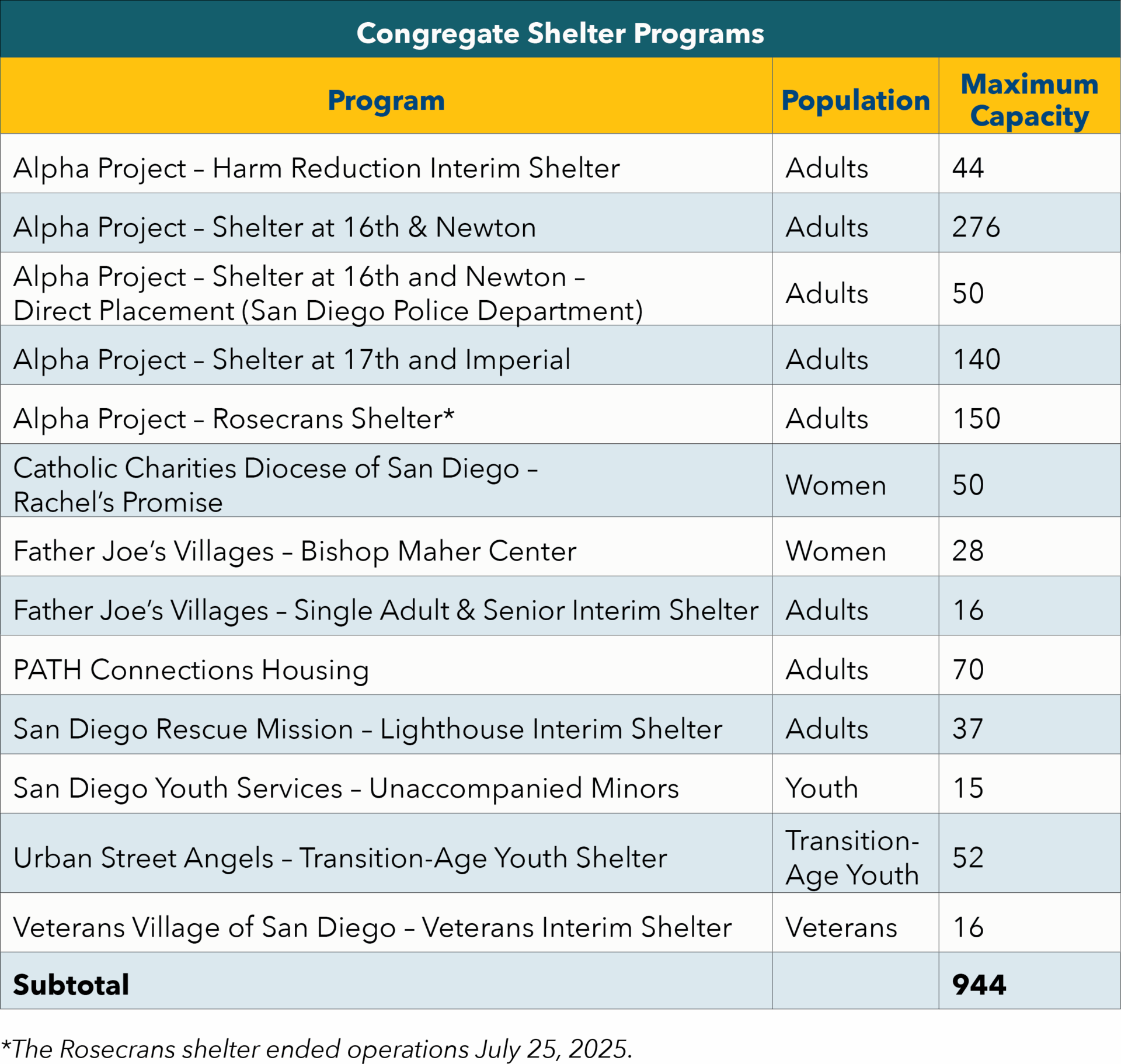
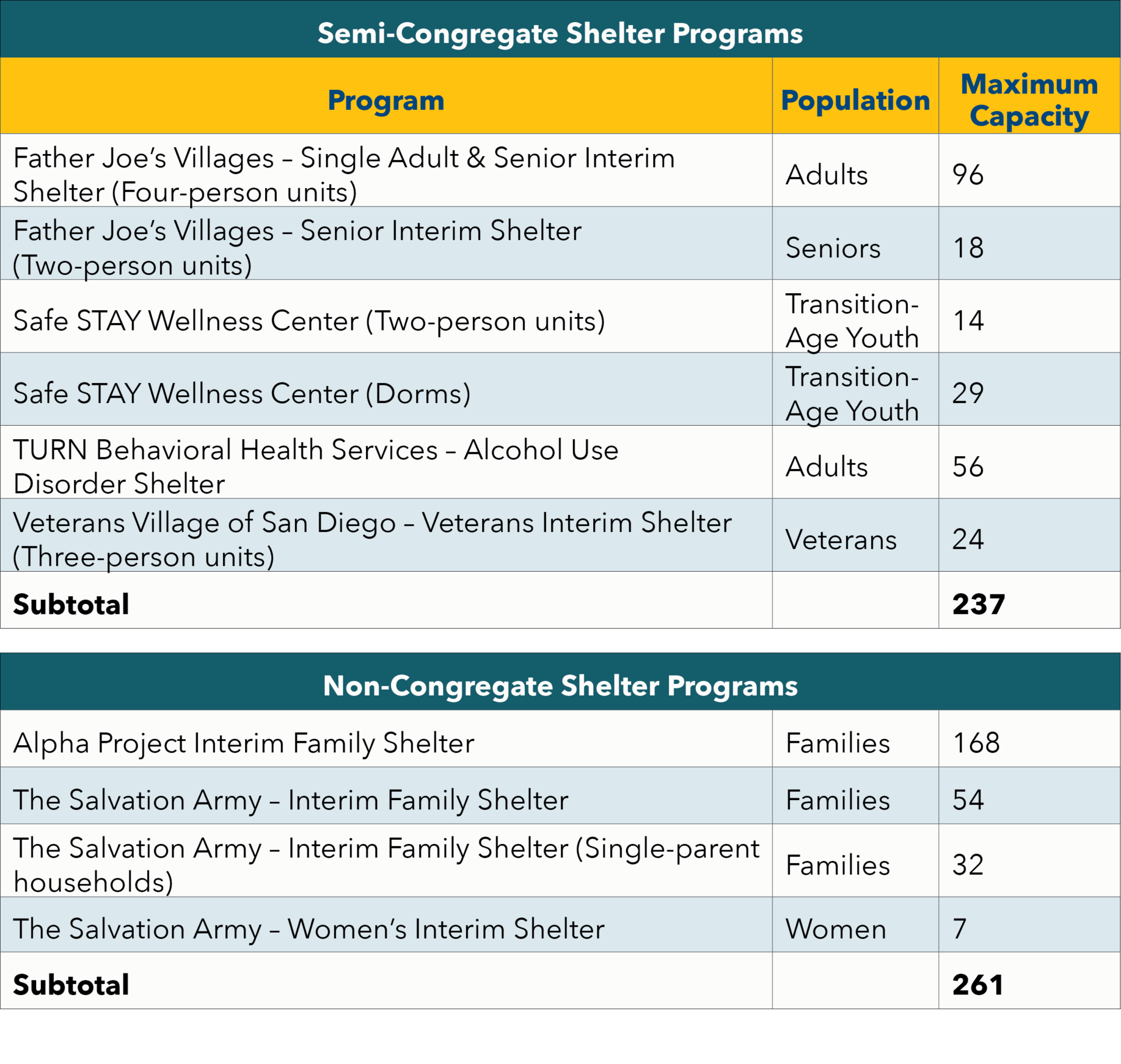
Shelter Programs’ Maximum Capacity on June 30, 2025
RACHEL’S PROMISE CENTER FOR WOMEN AND CHILDREN
A new site for Rachel’s Promise Center for Women and Children opened with more shelter bed capacity for women, with work underway to further expand to provide shelter for women and women with children. Property owners Dene Oliver and Jim McMillan worked closely with Catholic Charities, Diocese of San Diego to plan the site design and tenant improvements needed to expand the program’s shelter capacity and create semi-congregate and non-congregate shelter space for women and children.
New Site Announcement
- April 17, 2025
- Participants and attendees included:
- San Diego Mayor Todd Gloria
- San Diego City Councilmember Stephen Whitburn
- SDHC Commissioner Stephen Cushman
- SDHC President and CEO Lisa Jones
- Catholic Charities, Diocese of San Diego CEO Appaswamy “Vino” Pajanor
- Regional Task Force on Homelessness CEO Tamera Kohler
- Shelter capacity for women initially increased to 50, replacing a 40-bed location.
- Additional expansion will increase capacity to a total of approximately 109 beds for single women and 101 beds for women with children.
- The City of San Diego funds the shelter program.
- SDHC contracts with Catholic Charities, Diocese of San Diego to operate the program.
SAFE SHELTER FOR TRANSITION-AGE YOUTH (SAFE STAY)
The Safe STAY shelter program, serving unhoused transition-age youth, moved into a new site at converted office space in downtown San Diego that doubled the bed capacity for vulnerable people between the ages of 18 and 24. The site was configured to provide semi-congregate accommodations, which means shelter residents each have their own space within cubicles or shared rooms to provide more privacy than traditional congregate shelter settings. The configuration and support services were based on listening sessions, design planning and service-model feedback received from transition-age youth experiencing homelessness.
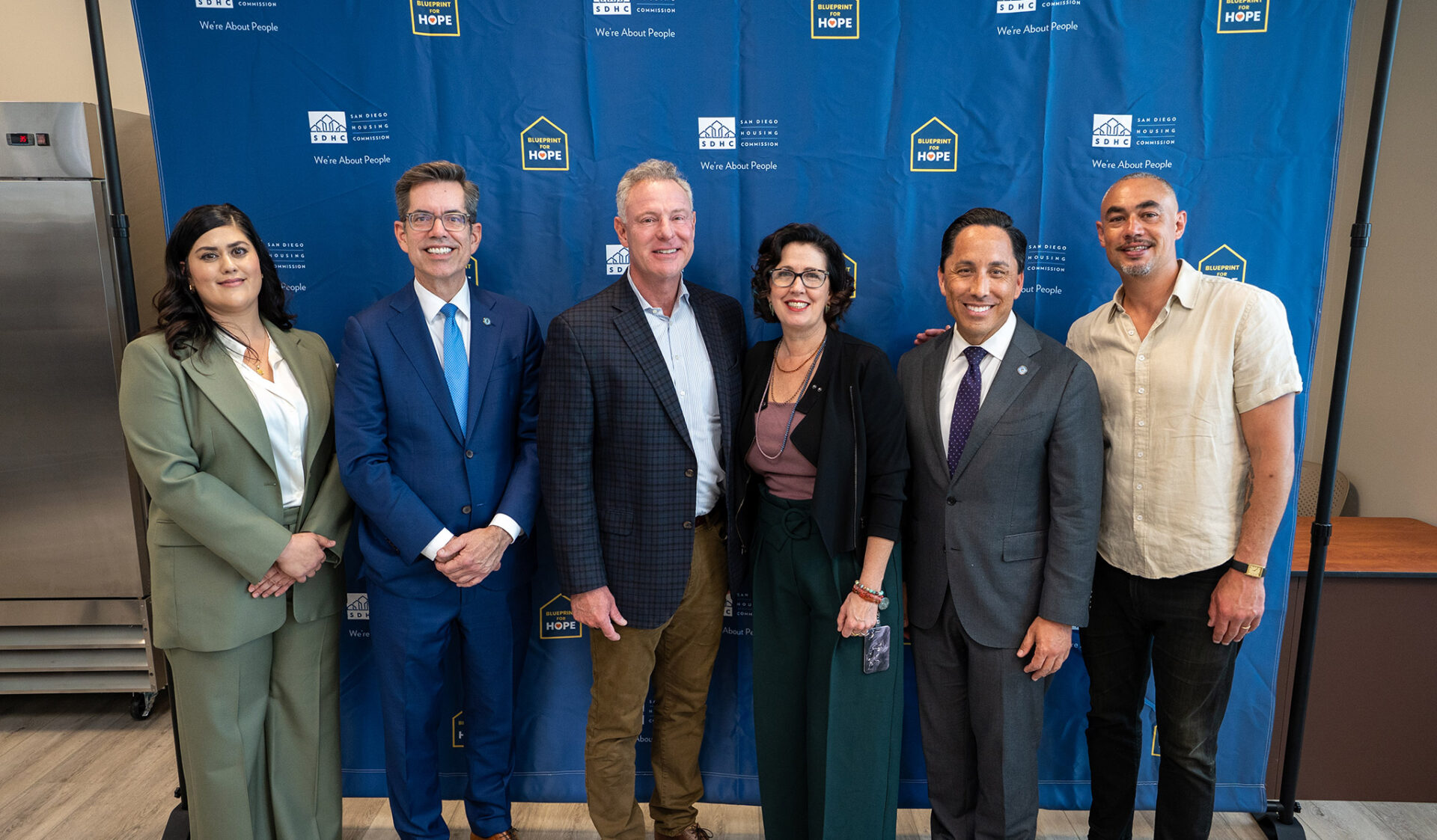
New Site Announcement
- April 11, 2025
- Participants and attendees included:
- U.S. Representative Scott Peters
- San Diego Mayor Todd Gloria
- San Diego City Councilmember Stephen Whitburn
- San Diego City Councilmember Sean Elo-Rivera
- SDHC President and CEO Lisa Jones
- The Center CEO Cara Dessert
- Shelter capacity increased to 43, replacing two interim sites that accommodated 21 youth.
- The City of San Diego funds the shelter program.
- SDHC contracts with The Center to operate program in partnership with San Diego Youth Services and the YMCA of San Diego County.

EXPANDED SHELTER OPTIONS
A package of new initiatives was announced in October 2024 to expand shelter and the options to address participants’ individual needs and provide a path toward resolving their homelessness. The new initiatives included adding beds to the shelter system at the Veterans Village of San Diego campus and through the San Diego Rescue Mission and TURN’s Alcohol Use Disorder program, as well as implementing a shelter-focused homelessness diversion effort to free up additional beds. These initiatives were the result of the Short-Term Action Plan on Homelessness that the City Council asked the City’s Homelessness Strategies and Solutions Department and SDHC to develop. The action plan was approved October 1, 2024.
Shelter-Focused Homelessness Diversion
SDHC, in collaboration with the Regional Task Force on Homelessness, the City of San Diego’s Homelessness Strategies and Solutions Department, and service providers, launched an initiative November 1, 2024, to focus diversion resources on connecting current shelter participants to longer-term housing more quickly, freeing up their shelter beds to serve others. The initiative’s goal was to exit 150 households to permanent housing.
154
Households exited to permanent housing
5-9%
Increase in exits to permanent housing compared to prior fiscal years
31%
Percentage of households exiting to permanent housing that received diversion support
Diversion Strategies
• Flexible financial assistance
• Shared housing
• Targeted case management
INCLEMENT WEATHER SHELTER PROGRAM
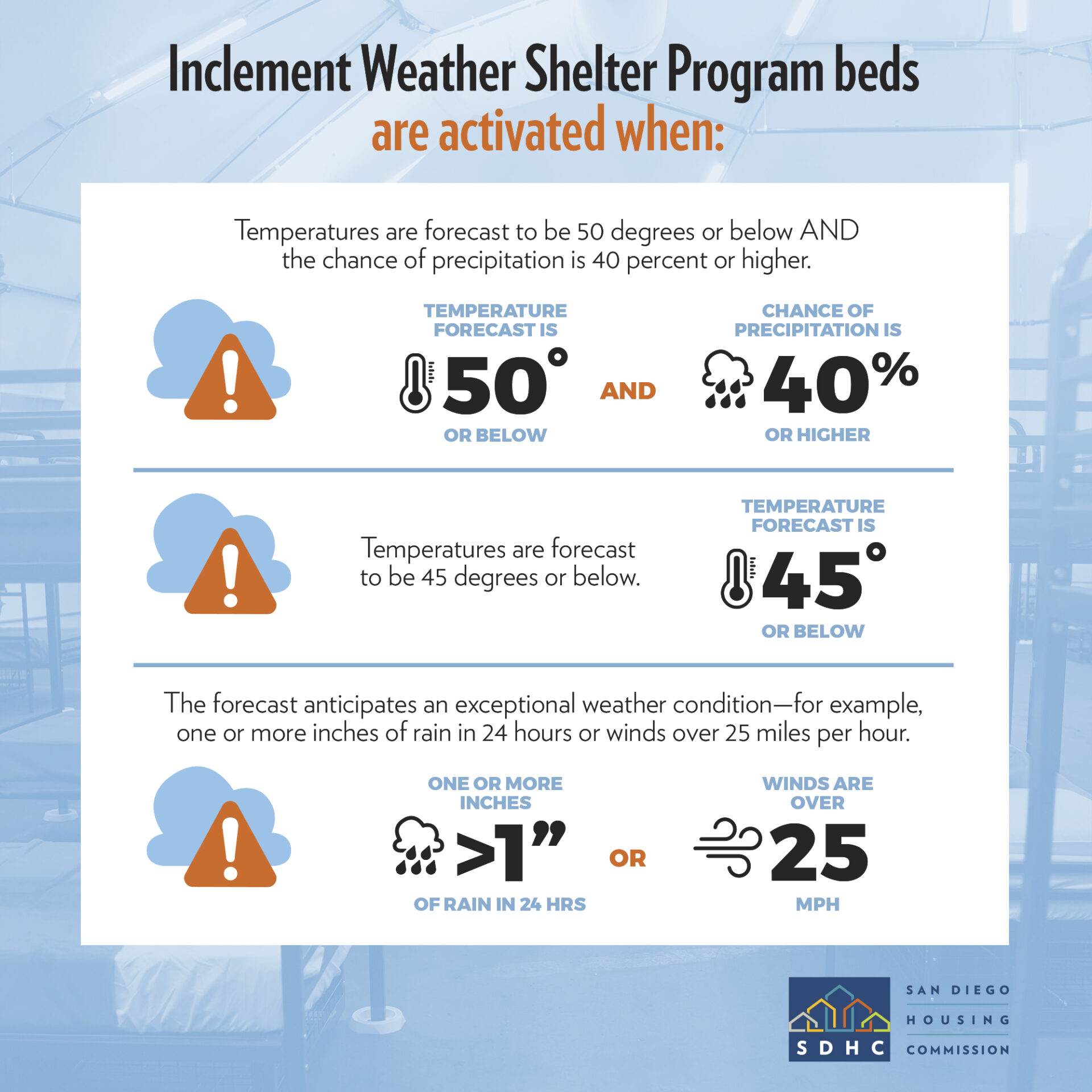
SDHC continued to collaborate with the City of San Diego, Father Joe’s Villages, and Living Water Church of the Nazarene to provide additional shelter beds during times of bad weather. A determination about the inclement weather shelter beds is made each day from November through March, based on the forecast and in consultation with service providers about their staffing and capacity.
Top Three Ways Individuals Heard about Inclement Weather Shelter
• 58% Word of mouth
• 20% Walked up to sites
• 10% Called 2-1-1

COORDINATED SHELTER INTAKE PROGRAM
SDHC developed an updated referral platform with the goal of shortening the time necessary to process shelter referrals and determine shelter placements (when beds are available) for San Diegans experiencing homelessness. This is essential, as San Diego has a continuously high demand for a limited number of shelter beds. If shelter is not available, individuals and families experiencing homelessness are notified in a timely manner, allowing them to investigate other options outside of the Coordinated Shelter Intake Program. The platform also supports transparency for the public and coordination among service providers who refer individuals experiencing homelessness to the Coordinated Shelter Intake Program, which SDHC operates.
Average Time to Notify a Client if They Secured a Shelter Bed

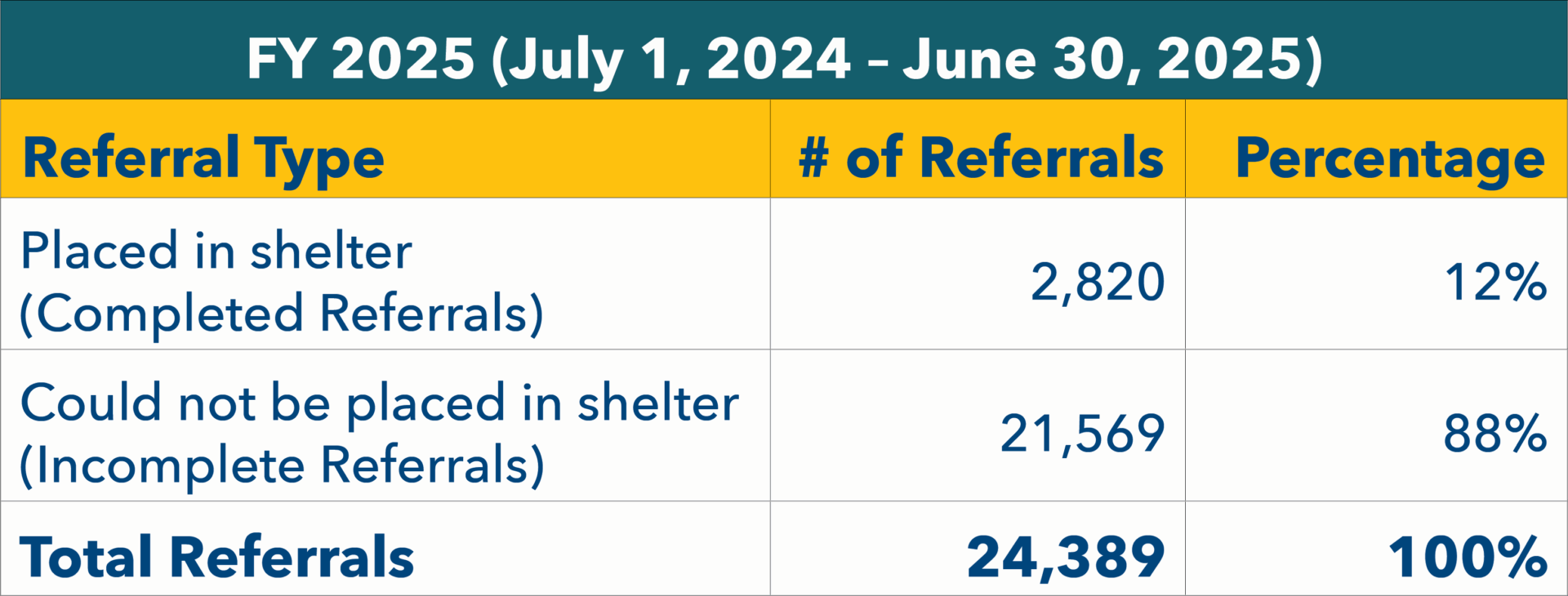
Most Frequent Reasons for Incomplete Referrals
Fiscal Year (July 1, 2024 - June 30, 2025)


UNIVERSAL TERMS OF SERVICE
SDHC led the development and implementation of universal policies and procedures for SDHC-administered homelessness shelter programs and the safe sleeping programs that the City’s Homelessness Strategies and Solutions Department administers. The Universal Terms of Service, Termination, Suspension & Appeals Policies and Procedures are the first of their kind in the San Diego community. They reflect a commitment to provide equity, access, transparency, and efforts to provide each program participant with the highest standard of care. Universal policies and procedures standardize practices and promote a uniform client experience across all of these City-funded shelter programs. The development of these policies and procedures included listening sessions and surveys conducted to solicit feedback from shelter residents about the content and implementation of the policies and procedures, which took effect October 1, 2024.
HOMELESSNESS RESPONSE CENTER
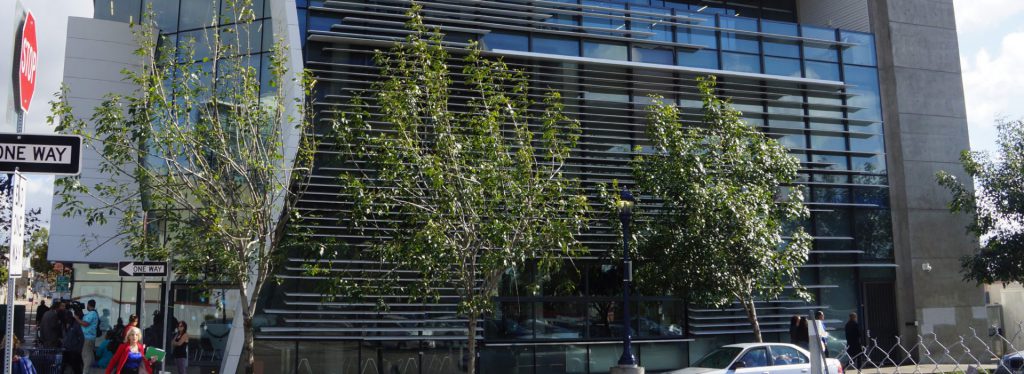
SDHC operated the City of San Diego Homelessness Response Center (HRC) to provide a broad range of services to help individuals and families experiencing homelessness on their path to permanent or other long-term housing. HRC’s main components were system navigation services, on-site supportive service providers, and SDHC’s system coordination team. SDHC contracted with People Assisting the Homeless (PATH) to offer system navigation and related services through HRC.
With plans to redevelop the HRC site to create affordable rental housing units, the City needed to identify an alternate location to operate the HRC. HRC’s operations at 1401 Imperial Ave. ended on June 30, 2025, and the program reopened July 16, 2025, as The Hub at the San Diego Central Library with the Downtown San Diego Partnership Foundation as the program operator through a contract with SDHC. SDHC’s system coordination staff continue to operate in coordination with The Hub.
FY 2025
SYSTEM COORDINATION
SDHC’s system coordinators work to identify areas within the system that are creating barriers to permanent housing and to collaborate with community partners to implement solutions. They work directly with service providers, housing providers and City and County agencies to proactively and reactively remove barriers to housing for people experiencing homelessness. The System Coordination team also works directly with clients as situations arise and often helps identify where the system may not be functioning optimally. For example, system coordinators are able to track progress on a client’s position in the approval process for housing and liaise between property management, compliance, rental assistance, and others to ensure communication to facilitate a successful housing placement.
HOUSING INSTABILITY PREVENTION PROGRAM
The Housing Instability Prevention Program (HIPP) helps pay rent and other housing-related expenses for families in the City of San Diego with low income, experiencing a housing crisis and at risk of homelessness. SDHC operates HIPP for the City of San Diego, which funds the program.
HIPP is a time-limited shallow subsidy program that helps to prevent homelessness among enrolled households. The program provides rental assistance, move-in cost assistance and case management services. HIPP works with participants to identify ways to reduce their housing costs or increase their income while they receive assistance.
HIPP households generally already reside in housing units that are more affordable than the market, but on average, their monthly income would need to increase about 30 percent just to reach a point where only half of their income went toward rent. As a result, longer-term assistance options are needed to continue to prevent homelessness among these households.

‘SUPER GRATEFUL’ FOR HER HOME
Three days from being evicted and managing chronic health issues, Noreen was able to stabilize her housing and return to a more active lifestyle with the assistance she receives from SDHC’s Housing Instability Prevention Program (HIPP).
“I was totally worried, yeah,” Noreen said. “Plus, I need hip surgery, so I’m in a lot of pain like 24/7. So, it was scary to me that I would have to live in my car or go downtown and walk around old with pain. It was scary, but I still tried not to worry, and I have faith, and I believed in God, and it was like, that’s why I say it was like a miracle.”
Before receiving the eviction notice, Noreen’s budget was already strained. A retired grocery store cashier, she was paying $1,285 a month in rent for her Linda Vista apartment—roughly 95 percent of her income from Social Security and Supplemental Security Income.
That left her with about $60 a month for the rest of her expenses.
“My budget was tight, and you learn how to live with what you have,” she said.
Ultimately, she fell behind on her rent payments, and the eviction notice left her feeling “hopeless.”
Noreen contacted her former pastor, who recommended she call 211 San Diego, which connected her with HIPP. An SDHC housing specialist spoke to her landlord, who agreed to hold off on the eviction.
Now that she’s enrolled in HIPP, she said her life – and her budget – have greatly improved.
With better financial standing has come better health for Noreen. Once depressed and living as a “recluse” in her apartment, she’s now taking regular walks and bike rides and enjoys swimming in a pool near her daughter’s house.
“Having a home base really means a lot. My grandkids and my family, they don’t worry about me. They know I have a place where I’m happy. I have good neighbors,” Noreen said. “I’m very grateful to have this home. Super grateful.”
FEELING ACCOMPLISHED AFTER A STRUGGLE
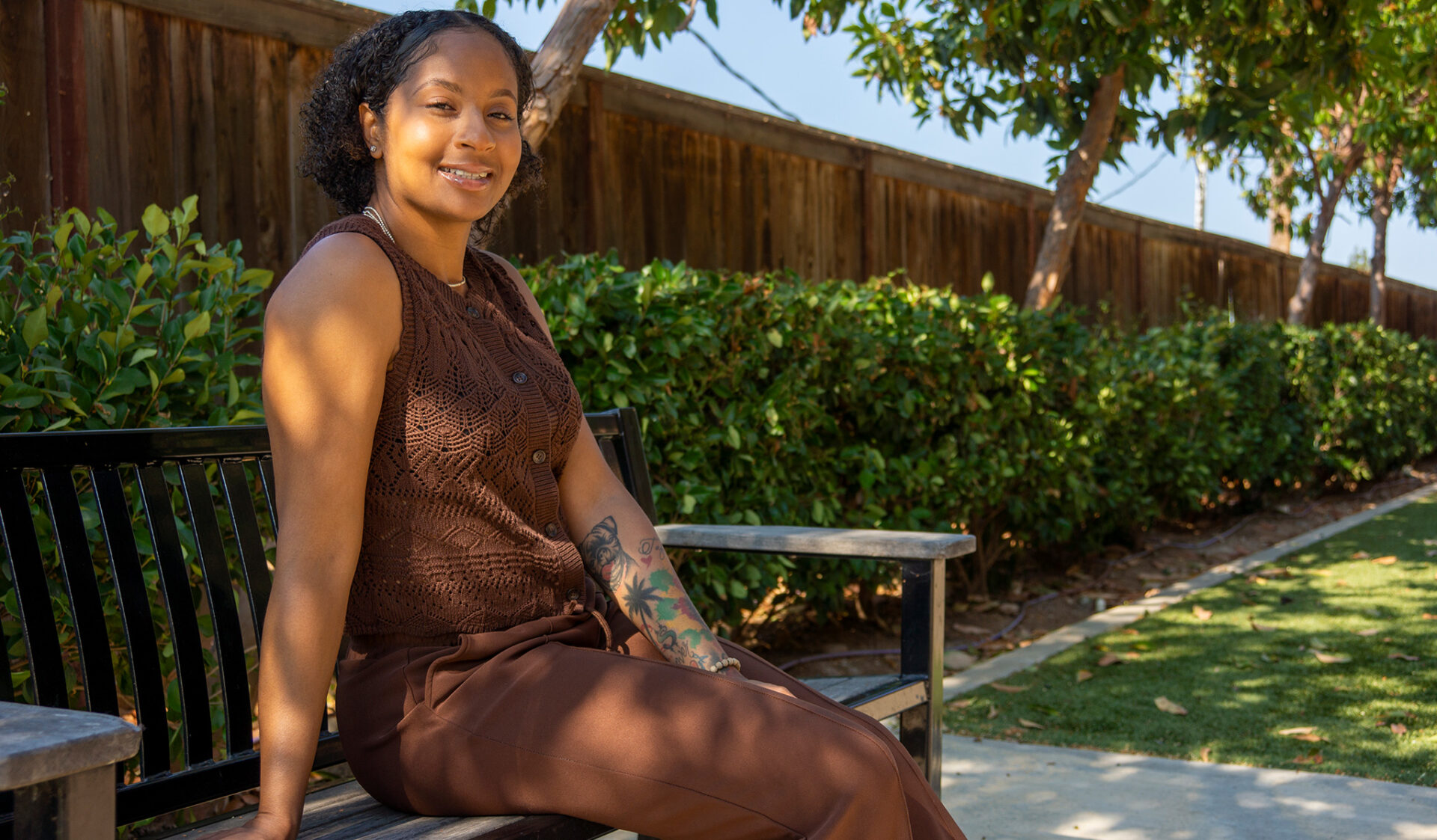
Drowning in debt and spending the bulk of her income on rent, single mom Deanna remembers being in a “dark place.” But everything changed after receiving assistance from SDHC’s Housing Instability Prevention Program (HIPP).
“I’m just so happy that there’s resources out there to help people because when you’re in the midst of feeling like you’re drowning or you need help, it feels like the world’s against you and no one’s there,” Deanna said. “So, this opportunity was a great thing and experience to go through, and sitting here to even speak about it, I just want people to know not to give up, and be strong.”
When Deanna applied for HIPP in 2023, she was spending roughly 90 percent of her income on rent. It left little breathing room to pay her bills. She was unable to pay a “substantial amount” of past-due rent and anticipated having to give up her home and face penalties for the amount she owed.
A relative encouraged her to apply for HIPP, which helped with her rent arrears. The rent subsidy she received from HIPP enabled her to catch up on her bills and ultimately move with her 11-year-old son into another townhome that better fits her budget. She’s now spending a little less than 50 percent of her income on rent.
She’s also changed jobs and is now making more money, allowing her to successfully exit HIPP.
“I made it,” she said. “I no longer need the assistance, and I’m able to take care of things on my own. But when I got the email, I was really excited because how my specialist had worded everything. She said, ‘Great job. You did it. I’m proud of you.’”
Now, Deanna said she feels “accomplished.” For others struggling as she was, she recommends HIPP.
“I would say be patient, because when you’re feeling like you’re in need, everything’s a rush,” she said. “It’s the anxiety that hits you, your heart’s pounding, your mind’s going 10,001 places at one time. Just breathe and just know that there’s someone there on another end that’s wanting to see you succeed.”

SENIORS SAFE AT HOME PROGRAM
Seniors Safe at Home launched in October 2023 as a shallow subsidy program to provide time-limited rental and financial assistance as well as case management services to seniors 55 and older with low income, experiencing a housing crisis, and at risk of homelessness. Additional philanthropic funds were announced on June 16, 2025, to continue and expand the Seniors Safe at Home program. To enable the program to continue and serve more seniors, the Rancho Santa Fe Foundation will provide $100,000 in new program funding. The Lucky Duck Foundation is matching that amount and committed another $500,000 to the program for a total program budget of $700,000. Seniors Safe at Home is a collaboration among SDHC, Serving Seniors, The Lucky Duck Foundation and the Rancho Santa Fe Foundation.


Eviction Prevention Program
SDHC contracts with Legal Aid Society of San Diego to operate the Eviction Prevention Program, which serves renters with low income in the City of San Diego who are facing eviction for not paying their rent. The program includes full legal representation for eligible tenants throughout the pre-eviction and eviction process, in settlement negotiations and through trial, if necessary. The program also provides limited legal services for eligible tenants through clinics, hotlines or appointments (virtual or in person). Examples of limited legal services include submitting formal responses to eviction notices, formal responses to Unlawful Detainers, and requests for reasonable accommodations.
HOUSING FIRST – SAN DIEGO
Through its homelessness initiative, HOUSING FIRST – SAN DIEGO, SDHC has operated programs that directly assist individuals and families, awarded development funds and rental housing vouchers to produce affordable housing with supportive services, and administered special program housing vouchers that provide ongoing rental assistance and wraparound services in collaboration with community organizations. These efforts have created housing solutions for households at risk of or experiencing homelessness. Beginning in FY 2026, data about HOUSING FIRST – SAN DIEGO programs will be incorporated into reporting about the Community Action Plan on Homelessness for the City of San Diego and will not be reported separately.
Housing Solutions Created
HOUSING VOUCHERS FOR PEOPLE EXPERIENCING HOMELESSNESS
Approximately 35% percent of SDHC’s federal rental housing vouchers are committed to addressing homelessness. SDHC’s rental housing vouchers have provided housing solutions for households experiencing homelessness for more than 15 years.
HOMELESSNESS PREVENTION AND DIVERSION
SDHC’s Homelessness Prevention Program help individuals and families at imminent risk of homelessness to remain stably housed. Staff collaborate with households and landlords to resolve the household’s current housing crisis and provide tools and resources for ongoing housing stability. The program provides light-touch case management and short-term financial assistance to eligible households. Assistance may include landlord advocacy; housing location assistance; rental assistance (including rental arrears); financial assistance (including application fees, utility payments, moving costs, and security deposits); and referrals to external resources and supports.
Diversion is an approach that provides light-touch case management and short-term financial resources to eligible households who are homeless and accessing the homeless crisis response system. Staff work with the household to identify safe and immediate alternative housing options and to submit relevant referrals to services and financial resources to assist the household in stabilizing in permanent housing. Diversion services may include landlord advocacy; housing location assistance; rental assistance (including rental arrears); financial assistance (including application fees, utility payments, moving costs, and security deposits); and referrals to external resources and supports.
MOVING HOME RAPID REHOUSING
The Moving Home Rapid Rehousing program helps individuals and families experiencing homelessness to identify and maintain permanent housing. Staff work to rehouse the individual or family quickly and then provide case management services toward housing stability based on the household’s self-identified needs. The program’s services are time-limited and may include housing location services; case management; rental assistance (including rental arrears); financial assistance (including application fees, utility payments, moving costs, and security deposits); and referrals to external resources and supports.
LANDLORD ENGAGEMENT AND ASSISTANCE PROGRAM (LEAP)
As one of SDHC’s HOUSING FIRST – SAN DIEGO programs, LEAP provides incentives and benefits to landlords who rent to San Diegans experiencing homelessness, as well as housing location and financial assistance for tenants to pay security deposits and application fees. LEAP assists participants in a variety of HOUSING FIRST – SAN DIEGO programs—including Prevention, Diversion and Moving Home Rapid Rehousing—to locate and secure homes in San Diego’s rental housing market.
A ‘GREAT BENEFIT’ FOR LANDLORDS AND TENANTS
Towan has served as the property manager at Atmosphere, a 202-unit affordable apartment community in Downtown San Diego’s Cortez Hill neighborhood. Atmosphere includes 51 permanent supportive housing units for San Diegans experiencing homelessness.
So, with the permanent supportive housing, it’s a great partnership that the San Diego Housing Commission offers us.”
It allows the individuals to get back on their feet respectfully, and that’s helping them go from unhoused to being housed along with wraparound services.”
When it comes down to the LEAP program, that is another great benefit for landlords as well as for the tenants.”
Oftentimes the LEAP program also pays the security deposit for the individuals and also gives a contingency for any potential damages in the event that the person moves out within two years of residing there.”
That protection, if you will, allows an individual who may have made a mistake to not necessarily be punished indefinitely for the mistake that they made.”
The LEAP program is just that. Give the person a leap, allow them to take that leap with you, and you can reap the benefits just like they can.”
—Towan